What is the Ankle-Brachial Index (ABI)?
The Ankle-Brachial Index — commonly called the ABI — is a simple, quick, non-invasive measurement that compares the blood pressure at your ankle to the blood pressure at your arm (brachial artery). The result gives your doctor a reliable snapshot of how well blood is moving through the arteries in your legs.
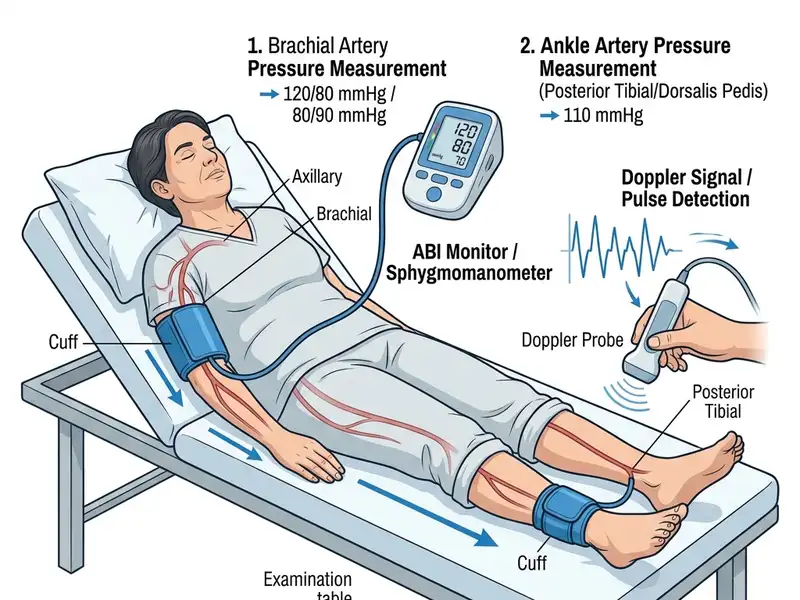
When the arteries supplying your legs are healthy and wide open, ankle and arm pressures are roughly equal. When a blockage or narrowing exists, the pressure at the ankle drops relative to the arm. The bigger that gap, the more restricted the blood flow — and the more likely you are to have Peripheral Artery Disease (PAD), a condition affecting an estimated 10 to 12 million Americans and millions more Canadians.
PAD is a major risk marker for heart attack and stroke — not just leg problems. People with a low ABI are 2–4 times more likely to have a cardiovascular event within 10 years. That's why early detection through the ABI test can be genuinely life-saving.
Understanding Your ABI Score — What the Numbers Mean
The ABI score is a ratio. A score of 1.0 means your ankle pressure equals your arm pressure — perfectly normal. Below is what each range means in plain language:
| ABI Score | Category | What It Suggests | Recommended Action |
|---|---|---|---|
| Above 1.40 | Non-Compressible | Stiff, calcified arteries — result may be unreliable | Ask about Toe-Brachial Index (TBI) test |
| 1.00 – 1.40 | Normal | No significant blockage detected | Maintain healthy habits; annual check if high risk |
| 0.91 – 0.99 | Borderline | Possible very early narrowing | Lifestyle changes; follow-up with doctor |
| 0.70 – 0.90 | Mild PAD | Mild arterial blockage; may have leg cramping on exertion | Supervised exercise; medication evaluation |
| 0.41 – 0.69 | Moderate PAD | Significant blockage; likely leg pain when walking | Vascular specialist referral; treatment needed |
| 0.40 or below | Severe PAD | Critical blockage; possible rest pain or wounds | Urgent vascular specialist evaluation |
For a complete breakdown of what each range means and what to do next, read our guide on ABI normal range and score interpretation.
Who Should Get an ABI Test?
The American Heart Association (AHA) and the American College of Cardiology (ACC) recommend ABI screening for people with specific risk factors. You should talk to your doctor about an ABI test if you:
- Are 50 years or older with a history of diabetes or smoking
- Are 65 years or older, regardless of other risk factors
- Have leg pain, cramping, or weakness when walking that goes away with rest (intermittent claudication)
- Have a known history of cardiovascular disease, heart attack, or stroke
- Have poorly controlled high blood pressure or high cholesterol
- Have non-healing wounds or sores on your feet or legs
How Is the ABI Calculated?
The formula is straightforward:
ABI = Ankle Systolic Pressure ÷ Arm (Brachial) Systolic Pressure
For example: If your highest ankle pressure is 130 mmHg and your highest arm pressure is 120 mmHg, your ABI is 130 ÷ 120 = 1.08 — normal range. Our calculator above handles this automatically. Just enter your two numbers and click "Calculate."
In a clinical setting, a trained technician measures blood pressure in both arms and both ankles using a standard blood pressure cuff and a hand-held Doppler ultrasound probe. The highest readings from each side are used. Learn the full procedure in our step-by-step ABI test guide.
Peripheral Artery Disease (PAD) — The Big Picture
PAD is caused primarily by atherosclerosis — the same process that causes coronary artery disease and leads to heart attacks. Fatty deposits (plaque) build up inside the artery walls over years, narrowing the channel and restricting blood flow. When this happens in the leg arteries, it's called PAD.
The frightening reality is that up to 50% of people with PAD have no symptoms at all. The most common symptom — leg cramps or pain when walking that goes away with rest — is often dismissed as "just getting older." This is why routine ABI screening is so important for anyone in a high-risk group. Read more about PAD symptoms and when to see a doctor.
Can You Improve Your ABI Score?
Yes — and this is important. An ABI score is not a life sentence. For people with mild to moderate PAD, lifestyle changes and medical treatment can genuinely improve blood flow, reduce symptoms, and in some cases move your score back into a healthier range. The most evidence-backed approaches include:
- Supervised exercise therapy: The 2024 ACC/AHA guidelines list this as the #1 treatment for claudication. A 12-week walking program can dramatically increase pain-free walking distance. Medicare now covers supervised exercise therapy for PAD. Learn about exercise therapy for PAD →
- Quitting smoking: Smoking is the single biggest modifiable risk factor for PAD. Within weeks of quitting, circulation begins to improve.
- Diet changes: A Mediterranean-style diet rich in olive oil, fish, vegetables, and whole grains has been shown to reduce inflammation and slow plaque progression. Read our PAD diet guide →
- Medication: Statins, blood pressure medications, and antiplatelets (aspirin, clopidogrel) are standard. The 2024 guidelines also now recommend low-dose rivaroxaban combined with aspirin for eligible patients.
- Blood sugar control: For people with diabetes, tight glucose management is critical for slowing PAD progression. Read about ABI testing in diabetics →
ABI vs. Other Vascular Tests
The ABI is the first-line test for PAD — cheap, fast, and non-invasive. But it's not the only tool. In people with very stiff arteries (a common finding in diabetes and kidney disease), an ABI above 1.40 makes the result unreliable. In these cases, the Toe-Brachial Index (TBI) is used instead — it measures toe pressures, which are less affected by calcification. Read our full ABI vs TBI comparison to understand when each test is appropriate.