Sudden severe leg pain + cold, pale, or blue leg + inability to move the foot → This could be acute limb ischemia, a vascular emergency. Call 911 immediately — minutes matter.
The Symptom That Defines PAD: Intermittent Claudication
The classic and most recognizable symptom of PAD is called intermittent claudication — a Latin term (from "claudicare," meaning to limp) that describes a very specific pattern of leg discomfort. Here's what makes it distinct from ordinary muscle aches:
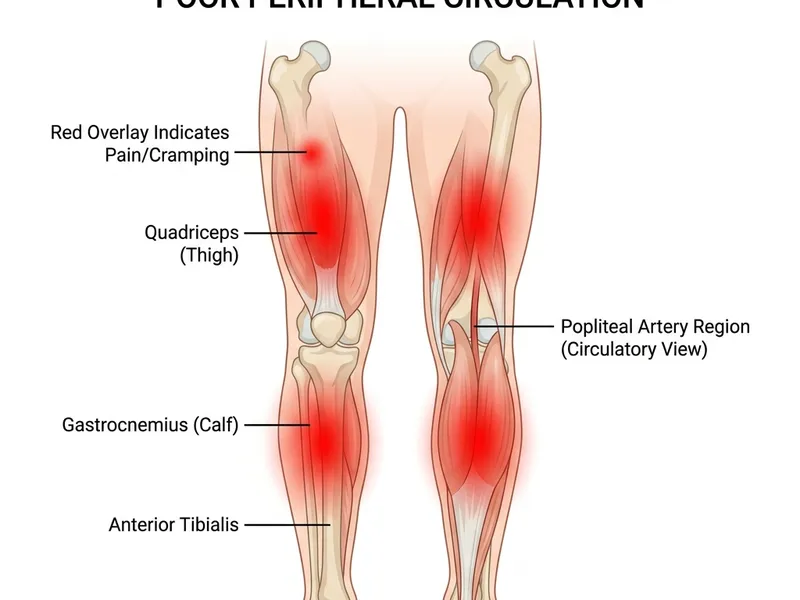
- It comes on during walking or exercise — reliably, predictably, usually after a consistent distance
- It's described as cramping, aching, heaviness, burning, or tightness — most commonly in the calf, but can be in the thigh, hip, or buttock depending on where the blockage is
- It disappears completely within 1–5 minutes of rest — without changing position (you don't need to sit down, just stop walking)
- It returns at the same walking distance each time — this consistency is highly characteristic of PAD versus other causes of leg pain
This pattern occurs because at rest, the limited blood flow through a narrowed artery is sufficient. But during exercise, muscles demand far more oxygen-rich blood — and the narrowed artery can't deliver enough. The resulting oxygen debt is felt as pain. When you stop, oxygen demand drops back to resting levels, the debt is repaid, and the pain resolves.
For a complete guide to intermittent claudication — including grading, differential diagnosis, and treatment — see our dedicated intermittent claudication guide.
Why Up to 50% of PAD Patients Have NO Symptoms
This statistic — that roughly half of all people with PAD experience no symptoms — is one of the most important in vascular medicine, and one of the least appreciated. How can someone have narrowed leg arteries and feel nothing?
Several reasons:
- Sedentary lifestyle: If you don't walk far or fast, you may never trigger the oxygen demand that reveals claudication. Many elderly or activity-limited patients have PAD that would cause claudication at faster walking speeds but never challenges their daily activity level.
- Collateral circulation: The body is remarkable at adapting. Over years, as an artery narrows, the body gradually develops alternative "collateral" blood vessels around the blockage — natural bypasses that partially compensate for the reduced flow. These collaterals can be sufficient to prevent symptoms at rest or with mild activity.
- Diabetic neuropathy: People with long-standing diabetes often have nerve damage (peripheral neuropathy) that reduces sensation in the legs and feet. They may have severe PAD and tissue ischemia without feeling pain — a particularly dangerous combination because without the warning signal of pain, they may develop advanced complications before seeking care.
- Atypical symptom recognition: Many patients experience leg discomfort but attribute it to "aging," arthritis, or muscle fatigue — not recognizing it as vascular in origin. This misattribution is especially common in women, who tend to present with less "textbook" claudication than men.
The Full Spectrum of PAD Symptoms
Early-Stage PAD Symptoms (Often Dismissed)
- Leg fatigue or heaviness during walks that you didn't used to notice — especially on hills or stairs
- Mild calf tightness or "charley horse" sensation after walking a certain distance
- One foot or leg that feels colder than the other
- Slower toenail growth or leg hair loss — reduced blood flow affects nutrient delivery to skin and hair follicles
- Skin changes — the skin on the affected leg may appear shiny, tight, or unusually smooth
- Leg color changes — paleness when elevated, redness when dependent (dangling the foot)
Moderate PAD Symptoms
- Classic intermittent claudication limiting walking distance to under 200 meters
- Weak or absent pulses in the foot or behind the knee (detected by a physician on exam)
- Wounds or cuts on the feet that heal much more slowly than expected
- A bruit (whooshing sound) that a doctor can hear through a stethoscope over the affected artery
Severe PAD Symptoms — Critical Limb Ischemia
These symptoms require urgent medical evaluation — do not delay:
- Rest pain — burning, aching pain in the foot or toes that occurs even while lying down, especially at night. Classic pattern: hanging the foot over the edge of the bed provides mild temporary relief (gravity helps blood flow). This is a hallmark of critical ischemia.
- Non-healing ulcers or wounds on the feet or toes — often small at first (a blister, a nick from a shoe) but failing to heal over weeks. In diabetic patients, these can deteriorate rapidly without adequate blood flow.
- Gangrene — blackening or death of tissue, usually beginning at the tips of the toes. This is a vascular emergency.
PAD Symptoms in Women vs. Men
PAD presents differently in women, and this difference contributes to significant underdiagnosis. Research published in the Journal of Vascular Surgery and Circulation shows:
- Women with PAD are more likely to present with atypical leg pain (not classic claudication) — described as burning, aching at rest, or functional limitations not following the typical exertion-relief pattern
- Women are more likely to have asymptomatic PAD despite equivalent disease severity compared to men
- Women tend to receive fewer diagnostic tests and less aggressive treatment for PAD, even after accounting for disease severity — a disparity that is actively being addressed in clinical guidelines
- Women with diabetes plus PAD have particularly poor outcomes and warrant especially close monitoring
If you're a woman and your doctor seems to be attributing your leg symptoms to arthritis, aging, or muscle soreness — and those explanations don't feel right — advocate for an ABI test. Use our free ABI calculator to understand whether your readings warrant further evaluation.
Symptoms That Mimic PAD — Differential Diagnosis
Not all leg pain is PAD. Your doctor will need to consider other causes:
| Condition | Key Difference from PAD Claudication |
|---|---|
| Lumbar spinal stenosis (neurogenic claudication) | Also triggered by walking, but also by standing still; relieved by sitting or leaning forward; often bilateral; no pulse abnormality |
| Venous claudication | Tight, bursting sensation; worse after prolonged standing; associated with swelling; often in patients with previous DVT |
| Osteoarthritis of the hip or knee | Pain localized to joint; not relieved with standing still; no predictable walking distance trigger |
| Diabetic peripheral neuropathy | Burning, electric, or stabbing — often worse at night; not triggered by exercise; diffuse in stocking distribution |
| Muscle cramps | Often at night; not triggered by walking; abrupt onset; resolves with stretching |
When to See a Doctor — Do Not Wait
See your doctor promptly if you experience any of the following:
- Leg pain, cramping, or heaviness that consistently starts after a certain walking distance and reliably stops with rest
- A foot or leg that is noticeably colder than the other
- A sore, wound, or ulcer on your foot or leg that hasn't healed in 2+ weeks
- Skin color changes on your leg or foot (pale, red, or darkening)
- Pain in the foot at rest, especially at night
Seek emergency care immediately (call 911) if you have sudden onset of severe leg pain combined with a cold, pale, or numb leg — this can be acute limb ischemia and is a medical emergency where time directly determines limb survival.