The Modern PAD Treatment Philosophy
PAD treatment in 2026 is fundamentally different from how it was approached even a decade ago. The current framework, defined by the 2024 ACC/AHA Guidelines for Management of Patients with Lower Extremity PAD, emphasizes several core principles:
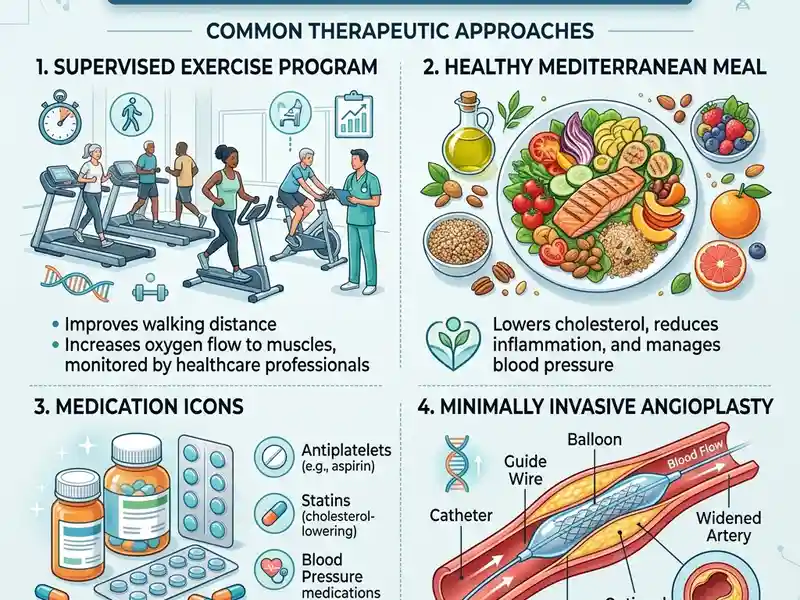
- Treat the whole patient, not just the leg: Since PAD patients have dramatically elevated cardiovascular risk (2–4x higher rates of heart attack and stroke), risk factor modification is as important as symptom relief
- Exercise before procedures: For claudication, supervised exercise therapy is the #1 first-line treatment — not angioplasty or stenting. Procedures are reserved for patients who fail to respond to exercise and medical therapy
- Limb salvage for CLTI: In patients with critical limb-threatening ischemia, the goal is to revascularize promptly to prevent amputation
- Individualized decision-making: Anatomy, comorbidities, functional status, and patient preferences all factor into choosing the right treatment
Supervised Exercise Therapy — The Undisputed #1 Treatment for Claudication
This is the most important thing you can read if you have mild to moderate PAD with claudication. The 2024 ACC/AHA guidelines give supervised exercise therapy a Class I, Level A recommendation — the highest possible evidence rating — for the treatment of claudication. That means the evidence is overwhelming, derived from multiple well-designed randomized trials.
Since 2017, Medicare covers up to 36 sessions of supervised exercise therapy over 12 weeks for PAD patients with claudication. Additional sessions may be covered with physician documentation. This is a major benefit — take advantage of it.
What Supervised Exercise Therapy Involves
This isn't just "go for walks." Supervised Exercise Therapy (SET) is a structured, medically monitored program with specific protocols:
- Frequency: 3 sessions per week, typically for 12 weeks (36 sessions total)
- Exercise type: Treadmill walking is the most evidence-based modality. The protocol uses intermittent walking — walk to near-maximal claudication pain, rest until it resolves, then walk again
- Intensity: The walking pace and incline are progressively increased as you improve — this is called "progressive overload" and is the key to improvement
- Supervision: A physical therapist, exercise physiologist, or cardiac rehabilitation specialist monitors you throughout each session, recording symptoms, heart rate, and blood pressure
- Results: Meta-analyses of SET trials show average improvements in pain-free walking distance of 180–200% and maximum walking distance of 120–150% after 12 weeks. ABI often improves by 0.10–0.15 points.
For a complete guide to exercise programs for PAD — including at-home alternatives and what to expect — see our dedicated exercise therapy for PAD page.
Lifestyle Modification — The Foundation of PAD Management
Every PAD treatment plan, regardless of how advanced the disease, must include these evidence-backed lifestyle changes:
Smoking Cessation
If you smoke and you have PAD, quitting smoking is the single most impactful thing you can do. The evidence is unambiguous:
- Smoking accelerates PAD progression 2–4x faster than in non-smokers
- People who continue smoking after endovascular procedures have dramatically higher rates of re-stenosis (the artery narrowing again)
- Within 1–2 years of quitting, ABI values measurably improve
- Combination therapy — nicotine replacement plus varenicline (Chantix) or bupropion — has the highest quit rates. Ask your doctor about prescription options.
Cardiovascular Risk Factor Control
- Statin therapy: All PAD patients should be on a high-intensity statin (rosuvastatin 20–40mg or atorvastatin 40–80mg) regardless of their LDL level. Statins stabilize existing plaques and reduce inflammation beyond just lowering cholesterol.
- Blood pressure control: Target <130/80 mmHg for most PAD patients. ACE inhibitors and ARBs are particularly beneficial due to direct vascular effects beyond BP lowering.
- Diabetes management: Target HbA1c below 7% (ideally 6.5%) in patients with diabetes and PAD. Poorly controlled diabetes dramatically accelerates PAD progression.
- Diet: Mediterranean-style diet reduces cardiovascular risk. See our PAD diet guide for specific recommendations.
PAD Medications — What's Changed in 2024–2026
Antiplatelet Therapy
Antiplatelet medications reduce the risk of clot formation in already-narrowed arteries and lower the risk of heart attack and stroke:
- Aspirin (75–100mg daily): Long-standing standard. The 2024 guidelines recommend aspirin for symptomatic PAD patients.
- Clopidogrel (Plavix, 75mg daily): An alternative to aspirin, or used in combination for high-risk patients. The CAPRIE trial showed clopidogrel was slightly more effective than aspirin for PAD specifically.
- Dual antiplatelet therapy (aspirin + clopidogrel): Used for 1–6 months after endovascular procedures and may be used in selected high-risk patients.
The 2024 Guideline Update: Rivaroxaban + Aspirin (COMPASS Regimen)
This is the biggest pharmacological update in PAD management in years. Based on the landmark COMPASS trial (published in NEJM), the 2024 ACC/AHA guidelines now give a Class I recommendation to low-dose rivaroxaban (2.5mg twice daily) combined with aspirin (100mg daily) for PAD patients who are at high risk for major cardiovascular and limb events and are not at high risk for bleeding.
The COMPASS trial showed this combination reduced major adverse cardiovascular events (heart attack, stroke, cardiovascular death) by 26% and major adverse limb events (including acute limb ischemia and amputation) by 46% compared to aspirin alone. This is a significant advance.
Emerging: GLP-1 Agonists for PAD
One of the most exciting developments in 2024–2025 is emerging evidence that GLP-1 receptor agonists — drugs like semaglutide (Ozempic/Wegovy) and liraglutide, primarily used for type 2 diabetes and weight loss — may have meaningful benefits for PAD patients. Data presented at the 2025 American College of Cardiology Scientific Sessions showed that semaglutide improved maximum walking distance and quality of life in patients with PAD and type 2 diabetes. More trials are ongoing to confirm these findings and determine whether the benefit extends to PAD patients without diabetes.
Cilostazol for Claudication
Cilostazol (Pletal) is the only FDA-approved medication specifically for claudication symptoms. It inhibits platelet aggregation and is a phosphodiesterase-3 inhibitor that promotes vasodilation. Studies show it improves maximum walking distance by 25–50% compared to placebo. It is contraindicated in patients with heart failure. Pentoxifylline is a less effective alternative.
Endovascular Procedures
When lifestyle changes and medical therapy don't adequately control claudication symptoms, or in cases of more severe disease, endovascular procedures (minimally invasive catheter-based techniques) can physically restore blood flow:
Balloon Angioplasty (PTA)
A catheter with a small balloon at its tip is threaded through the artery to the site of blockage (usually accessed through a puncture in the groin or wrist). The balloon is inflated to compress the plaque and widen the channel. This is the simplest endovascular technique and often combined with stenting.
Drug-Coated Balloons (DCBs)
An evolution of standard angioplasty, DCBs are coated with paclitaxel (a drug that inhibits cell growth) to prevent the artery from re-narrowing after treatment (restenosis). Multiple randomized trials have demonstrated that DCBs provide more durable results than plain balloons for femoropopliteal disease (the thigh and knee arteries). DCBs are now a standard treatment option for these locations.
Stenting
A small metal mesh tube (stent) is deployed at the site of blockage to physically hold the artery open after angioplasty. Self-expanding nitinol stents (made of a nickel-titanium alloy that springs back to shape) are preferred for the superficial femoral artery and popliteal artery, which are subject to bending forces during walking.
Atherectomy
Atherectomy devices physically remove plaque from inside the artery, rather than just compressing it. Several types exist: directional atherectomy, rotational atherectomy, and laser atherectomy. These are particularly useful for heavily calcified lesions where balloons and stents may not perform well.
Surgical Bypass
Open surgical bypass remains an important treatment for complex PAD, particularly for long occlusions or multiple-level disease that isn't suitable for endovascular treatment:
- Aortobifemoral bypass: A Y-shaped graft connects the aorta to both femoral arteries, bypassing blockages in the iliac arteries. This is a major surgery but provides excellent long-term results (10-year patency rates exceeding 80%).
- Femoral-popliteal bypass: A graft (ideally the patient's own saphenous vein from the leg) connects the femoral artery above the knee to the popliteal artery below the knee, bypassing femoral artery disease. Vein grafts are far superior to synthetic grafts for below-knee bypasses.
- Femoral-tibial bypass: For disease extending to the lower leg arteries, bypass to the tibial arteries may be required — particularly for limb salvage in CLTI.
Treatment for Critical Limb-Threatening Ischemia (CLTI)
CLTI (ABI typically <0.4, with rest pain, ulcers, or gangrene) requires a different, more urgent approach than claudication. The immediate goals are: control infection if present, revascularize to restore blood flow, and achieve wound healing to save the limb.
The 2024 BEST-CLI trial findings (published in NEJM) provide important guidance: in patients with CLTI who have an adequate saphenous vein available, open surgical bypass with vein graft is superior to endovascular treatment for limb salvage and event-free survival. In patients without adequate vein, or who are high surgical risk, endovascular options are preferred. This nuanced guidance has changed practice for many vascular surgeons.
Emerging and Experimental Therapies
Research in PAD treatment is actively advancing:
- Gene therapy: Clinical trials are exploring intramuscular injection of genes encoding vascular endothelial growth factor (VEGF) and fibroblast growth factor (FGF) to stimulate new blood vessel growth (therapeutic angiogenesis). Results have been mixed but research continues.
- Stem cell therapy: Studies on bone marrow-derived stem cells and mesenchymal stem cells aim to promote angiogenesis and tissue repair in patients with no revascularization options. Still largely experimental.
- Spinal cord stimulation: For patients with chronic pain from CLTI who cannot be revascularized, spinal cord stimulation can provide meaningful pain relief and may improve limb perfusion in some cases.
- Nanoparticle drug delivery: Research into targeted drug delivery via nanoparticles aims to deliver anti-restenosis drugs more precisely to the site of arterial intervention.
PAD Treatment Access in Canada
Canadian PAD patients have access to the full spectrum of treatments through the publicly funded healthcare system, though wait times for non-urgent procedures can be significant:
- Supervised exercise programs: Available through cardiac rehabilitation centers in most provinces, often with physician referral. Some provinces have dedicated vascular rehabilitation programs.
- Medications: Statins, antiplatelet agents, and cilostazol are covered by most provincial drug plans, though formulary coverage varies. Rivaroxaban may require special authorization in some provinces for PAD indications.
- Endovascular procedures: Available at major hospital centers in all provinces. Wait times for non-emergency procedures vary significantly — typically 2–6 months in most provinces.
- Vascular surgery: Available at academic medical centers and major regional hospitals. Urgent cases (CLTI) receive priority access.
For more on accessing PAD care in Canada, including provincial resources, see our PAD in Canada guide.