Understanding PAD Risk: Modifiable vs. Non-Modifiable
PAD risk factors fall into two categories: those you can change (modifiable) and those you can't (non-modifiable). Understanding both is important — non-modifiable risk factors tell you how vigilant you need to be, while modifiable ones represent your opportunity to genuinely reduce your risk.
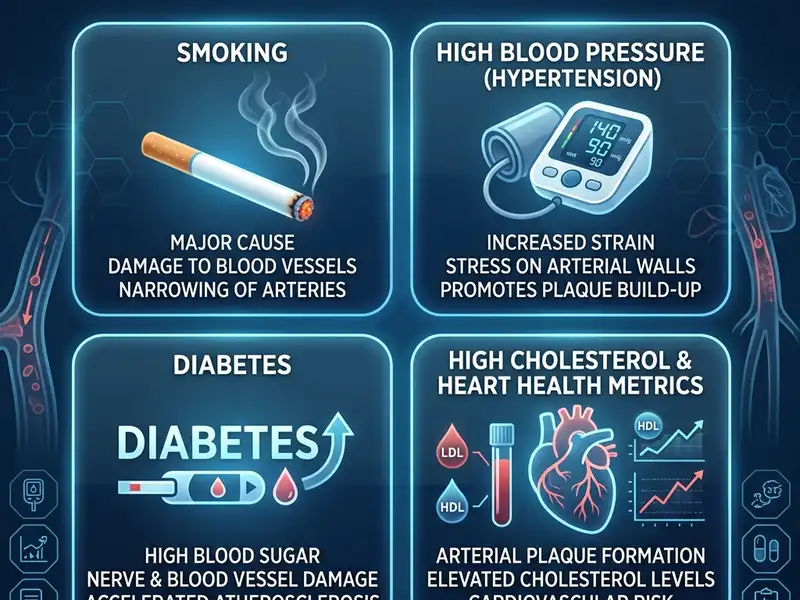
| Modifiable Risk Factors | Non-Modifiable Risk Factors |
|---|---|
| Cigarette smoking | Age (over 50) |
| Diabetes mellitus | Male sex (though women are catching up) |
| High blood pressure (hypertension) | Family history of cardiovascular disease |
| High cholesterol (dyslipidemia) | Race/ethnicity (Black Americans have highest rates) |
| Obesity | Chronic kidney disease (partially modifiable) |
| Physical inactivity |
Smoking: The Single Biggest Modifiable PAD Risk Factor
The relationship between tobacco use and PAD is among the strongest dose-response relationships in all of cardiovascular medicine. Current evidence shows:
- Smokers are 2–4 times more likely to develop PAD than non-smokers, after controlling for all other risk factors
- PAD is estimated to be attributable to smoking in up to 80–90% of cases in some populations
- The risk is proportional to pack-years of smoking (packs per day × years smoked) — the more you've smoked, the higher the risk
- Passive smoke exposure (secondhand smoking) also increases PAD risk
- Buerger's disease (thromboangiitis obliterans) — a specific type of inflammatory arterial disease — almost exclusively affects smokers under age 45
Why smoking damages arteries: Nicotine causes acute vasoconstriction. Carbon monoxide reduces oxygen delivery to tissues. Hundreds of other cigarette chemicals directly damage the endothelium (artery lining), accelerate oxidation of LDL cholesterol, increase platelet stickiness, and promote inflammation — all the core mechanisms that drive atherosclerosis.
US context: Approximately 11.5% of American adults (28 million people) still smoke as of 2024 CDC data. Smoking rates are higher among adults aged 25–44, those below the federal poverty level, and those without a college degree — demographic groups that also show disproportionately high PAD rates.
Canadian context: About 11% of Canadians smoke (Statistics Canada, 2023), with higher rates in some provinces (Manitoba, Saskatchewan, Nova Scotia).
What you can do: Quitting smoking — even after decades — reduces PAD risk and slows progression. Combination therapy (varenicline + NRT) has quit rates of 30–40% at 12 months. Your doctor can prescribe medication and refer you to cessation support. Canada's Health Canada smoking cessation resources and the US Smokefree.gov offer free help.
Diabetes: The Risk Factor That Changes Everything
Diabetes is the second most powerful PAD risk factor — and it fundamentally changes the character of the disease:
- People with diabetes have a 2–4 times higher risk of PAD compared to non-diabetics
- Diabetic PAD is typically more distal (affecting the calf and foot arteries more than the thigh) and more diffuse (involving multiple levels simultaneously)
- Peripheral neuropathy (nerve damage) makes diabetic patients less likely to feel claudication, meaning PAD is often not detected until it's at the critical limb ischemia stage
- Diabetic foot ulcers combined with PAD carry an extremely high risk of amputation without prompt treatment
- About 34.2 million Americans have diabetes (CDC, 2024) and an estimated 4 million Canadians — making this a massive population at elevated PAD risk
Read our dedicated guide to ABI testing and PAD in diabetic patients.
High Blood Pressure (Hypertension)
Hypertension is consistently present in 50–70% of PAD patients. The mechanism is well understood: high pressure physically damages the endothelial lining of arteries, creating entry points for LDL cholesterol and triggering the inflammatory cascade that builds plaque.
- Nearly 48% of American adults have hypertension (AHA, 2024) — about 122 million people
- In Canada, approximately 7.5 million adults have diagnosed hypertension, with millions more undiagnosed
- Every 10 mmHg increase in systolic blood pressure above 140 mmHg increases PAD risk by approximately 25%
- Hypertension control to below 130/80 mmHg reduces PAD progression and cardiovascular events
High Cholesterol (Dyslipidemia)
Elevated LDL cholesterol is the fuel that builds arterial plaques. The relationship between LDL and atherosclerosis is causal — confirmed by Mendelian randomization studies showing that genetically determined lifetime LDL exposure directly determines atherosclerosis burden.
- Each 40 mg/dL increase in LDL-cholesterol increases PAD risk by approximately 10–15%
- Low HDL cholesterol is independently associated with PAD risk
- Elevated triglycerides, particularly in the context of diabetes and metabolic syndrome, contribute to small-particle LDL — particularly atherogenic
- Statin therapy is indicated for all PAD patients regardless of LDL level, because statins reduce cardiovascular events through mechanisms beyond just cholesterol lowering
Age
PAD is predominantly a disease of older adults. Atherosclerosis is a lifelong cumulative process — decades of arterial damage from risk factors accumulate to the point where blood flow is eventually compromised. The age-related increase in PAD prevalence is dramatic:
- Ages 40–49: ~2–3% prevalence
- Ages 60–69: ~7–10%
- Ages 70+: ~15–20%
- Ages 80+: prevalence exceeds 20% in the general population and may reach 30–40% in high-risk subgroups
The 2024 ACC/AHA guidelines recommend ABI screening consideration for all individuals over age 65 and for those over 50 with additional risk factors (smoking or diabetes).
Race and Ethnicity: Profound and Troubling Disparities
PAD risk varies substantially by race and ethnicity in ways that reflect both biological and social determinants of health:
- Black Americans have approximately twice the PAD prevalence of white Americans across every age group, after adjusting for traditional risk factors. Among Black men aged 80+, some studies have found PAD prevalence exceeding 50%. This disparity is partially explained by higher rates of hypertension (a condition with particularly high prevalence and severity in Black Americans) and diabetes, but also by structural factors including healthcare access disparities.
- Hispanic/Latino Americans have intermediate PAD rates, with significant variation by subgroup. The Hispanic Community Health Study/Study of Latinos (HCHS/SOL) found PAD prevalence of approximately 8% among participants aged 45–74.
- Native American/First Nations populations in both the USA and Canada have disproportionately high diabetes rates (two to three times the general population rate), translating into substantially higher PAD burden. Indigenous communities in northern Canada face additional barriers to vascular care due to geographic isolation.
Family History and Genetics
PAD has a meaningful genetic component. First-degree relatives of PAD patients have approximately 2–3 times higher risk of developing the condition. Genome-wide association studies have identified multiple genetic variants associated with PAD risk, particularly those related to lipid metabolism, blood pressure regulation, and inflammatory pathways. A family history of early cardiovascular disease (heart attack before 55 in a male first-degree relative, before 65 in a female first-degree relative) should prompt earlier and more aggressive screening.
Chronic Kidney Disease (CKD)
CKD is both a strong independent PAD risk factor and a consequence of systemic atherosclerosis. Patients with CKD — especially those on dialysis — have dramatically elevated PAD rates:
- PAD prevalence in dialysis patients exceeds 30–40% in some studies
- CKD promotes arterial calcification (medial calcinosis), which not only predisposes to PAD but also makes ABI unreliable (causing falsely high readings) — requiring TBI testing
- The cardiovascular mortality risk from combined CKD + PAD is particularly high
Calculating Your Personal PAD Risk
If you've read this far, you may be wondering how your specific combination of risk factors translates into actual PAD risk. Here's a practical approach:
- One major risk factor (e.g., current smoker OR diabetes): Consider ABI screening if over age 50
- Two or more risk factors (e.g., diabetes + hypertension + family history): ABI screening is warranted from age 50, possibly earlier
- Over age 65 with any risk factor: ABI screening recommended by ACC/AHA guidelines
- Any symptoms (leg cramping when walking, feet colder than hands, slow-healing wounds): Seek evaluation regardless of age
Start with our free ABI calculator if you have blood pressure readings, and read about how to get a formal clinical ABI test.